
Nebius
SummaryWhat it does, the current narrative, risks and my take
What it does
A "neocloud": it rents specialized AI compute, with its own data centers full of Nvidia GPUs and software to run them, to those training and using AI models.
Current narrative
It's one of the key players in AI infrastructure: in 2026 revenue is multiplying, AI Cloud adjusted EBITDA margin is 53% and customers prepay for capacity. Expansion is funded with prepayments, debt and new shares.
Opportunities
- Compute demand growing faster than supply
- Customers prepaying for capacity
- It could become one of the big winners of AI infrastructure
Risks
- Capital intensity: ROIC barely above the cost of capital
- Debt and dilution to fund growth
- Uncertain future demand if part of AI runs on devices
My take
It's very interesting to follow closely, but it's a high-risk investment and, at this price, has no margin of safety in my base case. I'd rather wait for a price closer to my target or for execution to confirm the thesis.
Want to know when I update my analysis of Nebius?
Subscribe to the Substack for free and get a note whenever I publish a new company or change a valuation.
Updates
NBIS: Q3 2026 results: demand is plentiful, capacity is running lateNovember 12, 2026 — Alan
Nebius posted revenue of $981M in Q3 2026, up 571% year over year. The number needs a careful read, though: about $325M is non-recurring revenue from its asset-light model, where Nebius enables its platform on capacity funded by a partner. Excluding that, the recurring business generated about $656M, up 12% from Q2.
The good
- First positive EBIT since it began operating as Nebius: $50M, versus a $130M loss a year ago. The AI Cloud business had an adjusted EBITDA margin of 53%.
- Customers are paying up front. On contracts signed in Q3, prepayments cover more than 100% of the capex needed to serve them (50–60% in Q2). Deferred revenue, which is cash collected before the service is delivered, went from $1.6B to $9.4B in nine months.
- Prices are rising: annual contract value per MW exceeded $25M and the price per GPU-hour rose more than 20% versus Q2. It signed $12B in new contracts since July and added customers such as Databricks, Snowflake and Datadog.
- For 2027 it expects revenue of $12–13B and pre-tax breakeven in Q4 2027.
The weak
- It cut 2026 revenue guidance to the low end of the range, about $3.0B, because part of the third-party capacity (including the New Jersey site for Microsoft) slips into the first half of 2027. The ARR of more than $7B it expected for December now arrives in February.
- More capex: about $27B in 2026, against guidance of $20–25B, and between $40B and $45B in 2027.
- More debt and more shares. This year it issued $10.1B in convertible notes, ended September with $14.2B of debt and $7.4B of cash, and the share count went from 256M to about 298M.
- It stops reporting ARR, and remaining performance obligations (RPO, $38.7B) grew only 3% in the quarter.
What changed in the valuation
I updated the model with the September balance sheet, 2026 revenue in line with the new guidance and the guided capex for 2026 and 2027. I also added customer prepayments for the first time, since they are now a central source of funding. Prepayments add value, but the debt, the dilution and the higher capex take away more. The base case gives $88.63 with the perpetuity method and $140.43 with the exit multiple. The target price goes from USD 153 to USD 115.
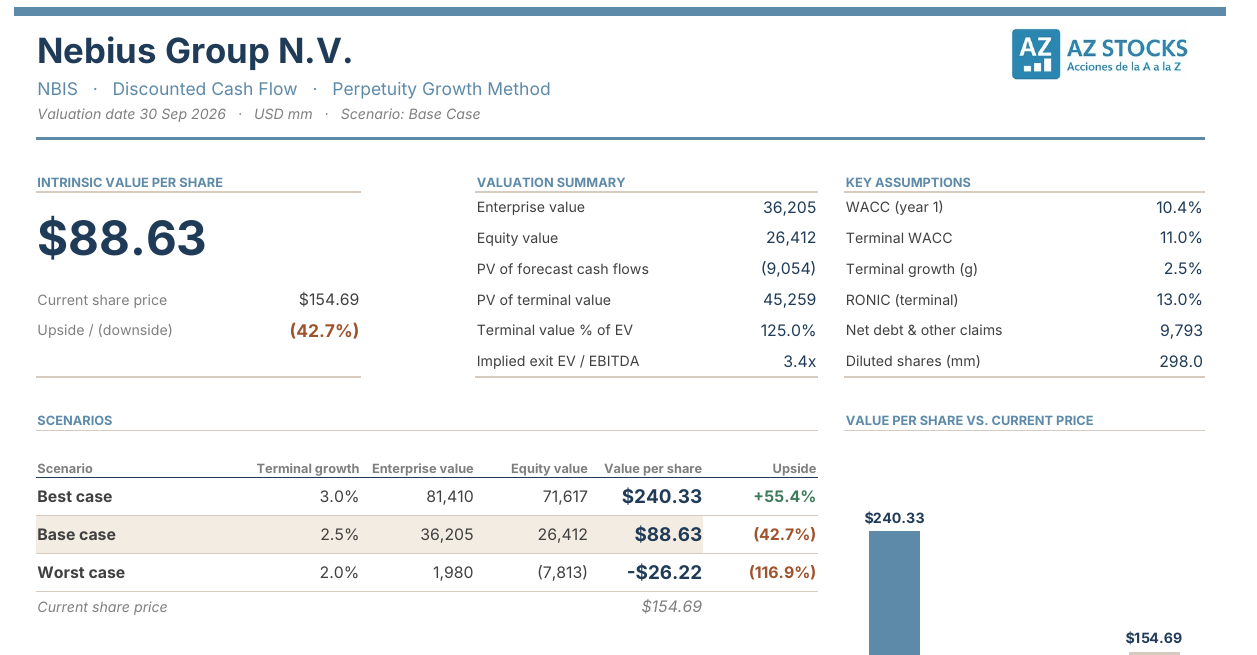
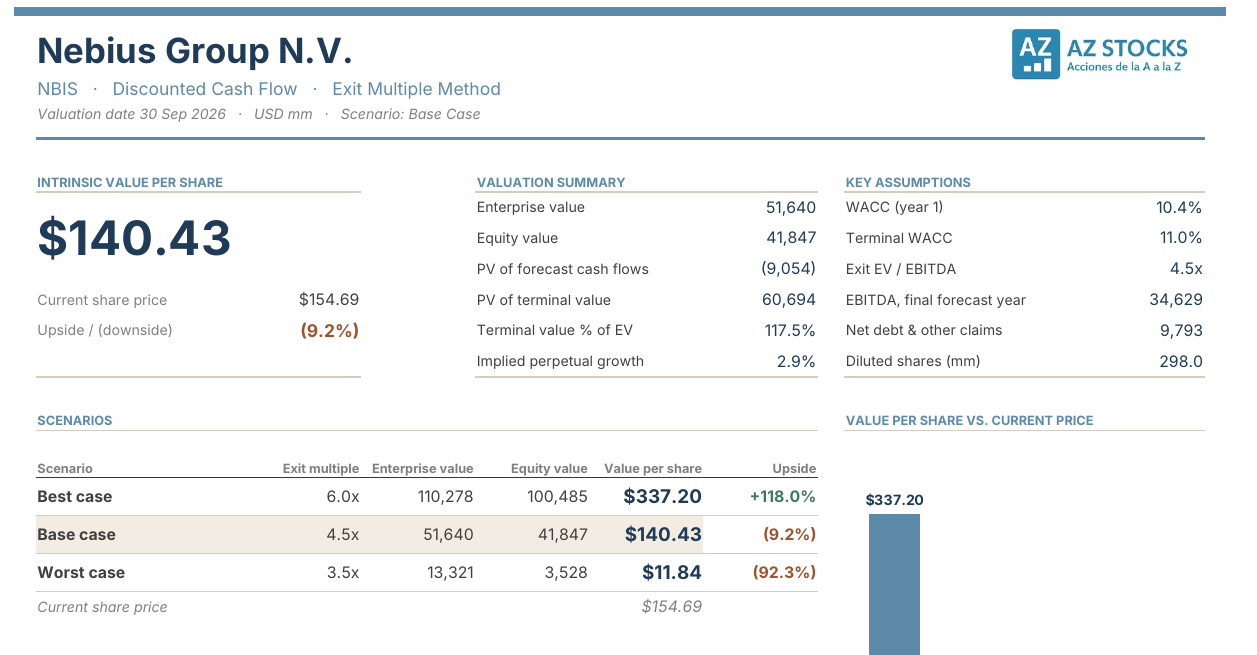
The thesis does not change: demand is not the problem and contracts keep getting better. What is at stake is bringing capacity online on time and how much capital it takes to do it. That is what I will be watching in the coming quarters.
Educational content. Not investment advice.